Specific Claims Negotiations
Negotiations Key Updates
- Background
As a background to the understanding of specific claims, First Nations have long had grievances related to the non-fulfilment of historic treaties or the mismanagement of Indian lands and monies. The Government of Canada has made successive attempts to address these issues.
Acho Dene Koe First Nation is not unlike other First Nations in Canada to these unfulfilled promises.
In 1948, a joint committee of the House of Commons and Senate acknowledged the need to appraise and settle First Nations claims and grievances in a just and equitable manner. The committee also recommended the creation of an independent administrative tribunal to adjudicate Indian claims and grievances. In 1973, the federal government established a policy and process to resolve outstanding First Nations claims. In 1982, the government refined the policy and process for the assessment and negotiation of specific claims. The goal of the policy was always to resolve claims through negotiation in the interest of fairness and reconciliation without involving the courts.
Specific claims generally refer to claims made by First Nations against the federal government. These claims relate to the administration of land and other First Nations assets and to the fulfilment of Indian treaties, although the treaties themselves are not open to renegotiation. Exhibit 6.1 provides some examples of the types of issues that could be the basis for specific claims.
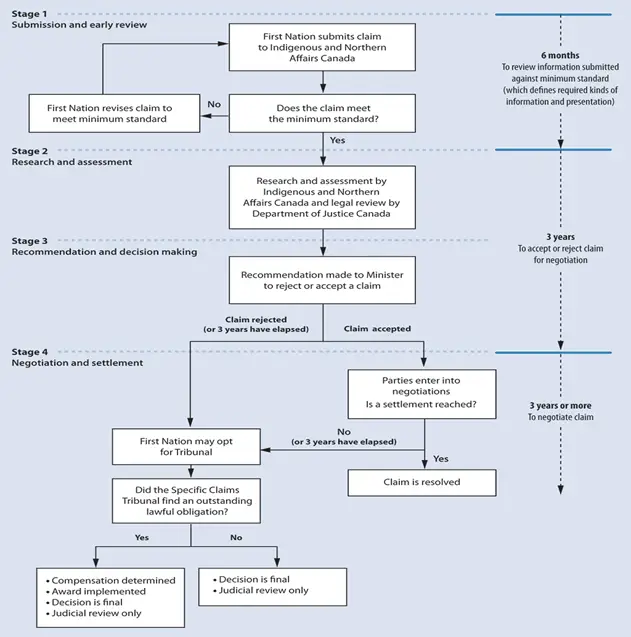
In 2006, the Standing Senate Committee on Aboriginal Peoples released a special study on specific claims. The report, entitled Negotiation or Confrontation: It’s Canada’s Choice, found the specific claims process to be both fraught with delay and so ineffective that it worked against the government’s objectives. The study reported that the government still judged and determined compensation for claims made against itself. Consequently, the government had not addressed First Nations’ concerns regarding the independence of the process. Additionally, the Committee heard that the process was confusing, complicated, time-consuming, expensive, adversarial, and legalistic. The Committee recommended that the government establish an independent body to resolve specific claims, dedicate a fund for specific claims settlements, and improve the specific claims process by providing additional resources. In 2007, Indigenous and Northern Affairs Canada introduced Justice at Last: Specific Claims Action Plan. In 2008, Parliament passed the Specific Claims Tribunal Act, which among other things established the Specific Claims Tribunal. This Act was developed in collaboration with the Assembly of First Nations. Justice at Last took effect in 2008 and was designed to:
- address the backlog of claims and their slow resolution,
- settle specific claims preferably through negotiation, and
- compensate First Nations for past damages associated with Canada’s outstanding lawful obligations.
Pillar | Government’s implementation |
Impartiality and fairness |
|
Greater transparency |
|
Faster processing |
|
Better access to mediation |
|
- Indigenous and Northern Affairs Canada is responsible for assessing and negotiating specific claims on behalf of the Government of Canada and for ensuring that Justice at Last is implemented cost-effectively. This accountability also extends to monitoring and reporting activities and results.
- The Department of Justice Canada advises Indigenous and Northern Affairs Canada on whether a specific claim discloses an outstanding lawful obligation for Canada, offers legal advice to Indigenous and Northern Affairs Canada during negotiations, and represents Canada before the Specific Claims Tribunal and the courts.
Claims preparation is complex.
Current Status of Negotiations
As of March 2025:
Specific claims negotiations are a relatively recent endeavour compared to other self-government, treaty, land claim, and reconciliation negotiations that are occurring in various forms with the governments of Canada, Northwest Territories, British Columbia, and Yukon.
In 2018, the Chief and Council approved the first initial research into the potential for filing specific claims against the federal government.
Currently, research efforts have led to submissions and agreed-upon negotiations by Canada to settle three claims without filing with the Specific Claims Tribunal. Prior to 2018, Acho Dene Koe First Nation had not pursued filing specific claims, even though such actions would not have impacted ongoing Land Claims, Treaties, or Self-Government Agreements negotiations. With new leadership and legal recommendations, efforts are underway to address these issues, with the intention that filing specific claims will directly benefit members.
Specific claims are distinct from comprehensive land claims or modern treaties.
The Government of Canada collaborates with First Nations to resolve outstanding specific claims through negotiated settlements. The specific claims process is voluntary for First Nations and offers an alternative to resolving disputes outside of the court system. Settling claims is the right course of action. Negotiated settlements honour treaty and other legal obligations and resolve longstanding disputes in a balanced manner that respects the rights of all Canadians.
Settlements provide First Nations with capital that can be invested in new opportunities for community and economic development, benefiting both First Nations and their neighbours.
Since March 2024, the Government of Canada has issued statements and entered negotiating agreements with Acho Dene Koe First Nation with the intent to negotiate the Treaty 11 Agricultural Benefits Claim (more commonly known as “Cows and Plows”), the Ammunition and Twine Benefits Claim, and the Failure to Provide Indian Reserve Status in British Columbia specific claim. A fourth claim has been filed, and a response from Canada is expected in 2025 regarding our submission concerning Treaty Land Entitlement for Treaty 11 in Northwest Territories.
Each of these three existing settlement discussions are conducted confidentially to prevent the claims from being adjudicated by the Specific Claims Tribunal.
- Agricultural Benefits Claim
With the Agricultural Benefits Claim (“Cows and Plows”), we have filed allegations that Canada is liable for Breach of Treaty 11, the Breach of fiduciary duty, and the Breach of Section 35 of the Constitution Act, 1982. We are seeking compensation for the losses incurred and the damages suffered because of the breach. Consideration of compensation will be guided by the compensation criteria of the Specific Claims Policy.
- Ammunition & Twine Claim
With the Ammunition & Twine Claim, we have filed allegations that the Government of Canada’s has failed to fulfil its obligation under the terms of Treaty 11 to provide ammunition, twine, and traps at a value of $3.00 per person, per year.
The Claim alleges that Canada has failed to fulfil its treaty obligations and also breached its legal, honourable and fiduciary duties when, among other things, it failed to provide ammunition, twine and traps in accordance with the terms of Treaty 11 from 1922 to 1952 (the “Non-Provision Breach”); and failed to index/adjust the $3 allocation to account for inflation since 1922, depriving of the value of the treaty promise (the “Indexation Breach”).
Canada has accepted that it owes compensation in relation to the Non-Provision Breach – that is, Canada’s failure to provide ammunition, twine, and traps in accordance with its treaty obligation for the 30-year period between 1922 and 1952. During this 30-year period, the evidentiary record suggests that Canada would supply ammunition, twine and/or traps to members at its discretion pursuant to welfare policies. This was not sufficient to fulfil Canada’s obligation under Treaty 11, which required it to provide those goods at the value of $3 per person, per year (irrespective of need). The Portion of Claim Not Accepted by Canada – Canada does not, however, accept the Claim as it relates to the Indexation Breach (Canada’s failure to adjust the $3 per person allocation in response to inflation). As a result, Canada is not prepared to provide compensation for the lost value of the treaty promise over time as inflation eroded the purchasing power of $3.
As a result, Acho Dene Koe First Nation has agreed to accept Canada’s offer to negotiate a settlement based on the Non-Provision Breach.
- British Columbia Reserve Creation Claim
The British Columbia Reserve Creation Claim is a potential claim arising from the Crown’s failure to protect and set aside as a reserve land habitually used and occupied by Acho Dene Koe First Nation in what is now Northern British Columbia, adjacent to British Columbia’s border with the Yukon and Northwest Territories.
Canada’s offered to negotiate a settlement.
Currently the research firm (The History Group) was retained by the First Nation in November 2024 to locate, identify and review research/evidence potentially relevant to the Claim and to prepare a final report based upon the same. Researcher began preliminary research, including collection of available documents and Access to Information and Privacy requests for documents not readily available. The researcher began drafting a preliminary draft report based upon the documents readily available/while awaiting result of Access to Information and Privacy document requests and in addition the following have transpired:
- Reporting meetings between legal counsel and the researcher to discuss claim scope and review claim feasibility
- Briefings between legal counsel and the First Nation
- Interview questions prepared for community knowledge holders